
With the 2024 Election rapidly approaching, we took a look at the impact of the last three election cycles on the MedTech and Biotech industries. Given recent headlines, this 2024 election cycle – especially as we approach the final stretch – is already unlike many that we have seen in recent history. As such, there is no telling if past precedence will yield similar results. Regardless, in a review of the US Medical Devices ETF (IHI), the S&P Biotech ETF (XBI), the S&P 500 (SPX) and the Russell 2000 (RUT) over the course of each election year since 2012, there are some trends of note.
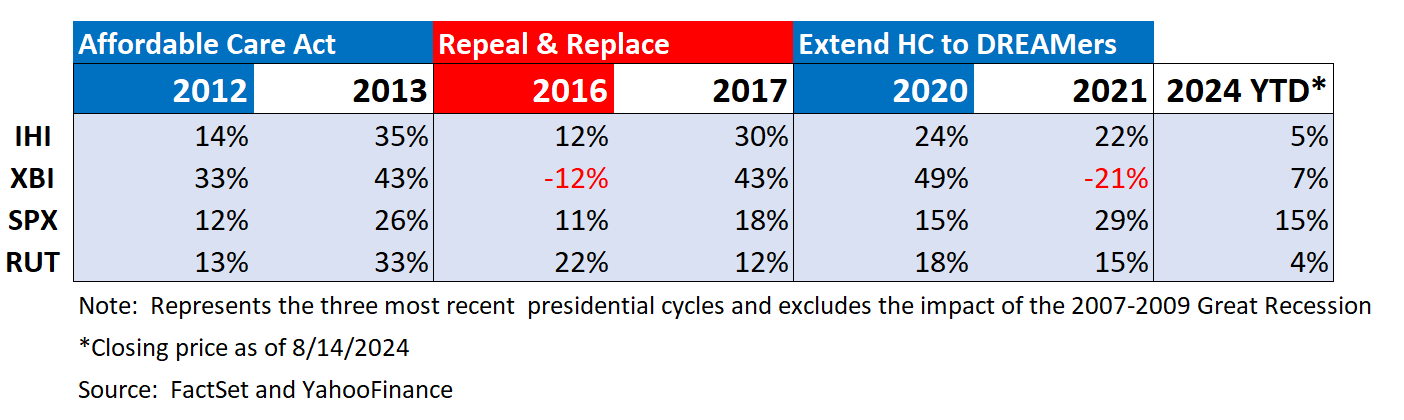
- Both the IHI and XBI outperformed the broader markets in the 2012 and 2020 election years, which yielded Democratic presidents, and underperformed in the 2016 election year of Republican candidate Donald Trump.
- In the year following the 2012 and 2016 election, regardless of the healthcare agenda, the IHI and XBI both drastically outperformed broader markets. In the year following the 2020 election, both the IHI and XBI underperformed the S&P 500 in a post-COVID-19 pandemic return to normalcy.
- In each of the last three election cycles, investor uncertainty created an overhang across all four indices leading into November, which quickly rebounded after the election.
- The last 3 election periods benefitted from low inflation and interest rates, with candidates and agenda well established heading into the conventions.
As we head into the November 2024 elections, there are many unknowns, particularly for the Democratic party. In comparison, the Republican party has proposed the following in its healthcare agenda:
- A requirement for federal agencies to purchase medicines and medical devices manufactured in the U.S. and bars foreign federal agencies from purchasing “essential” drugs; and
- A potential executive order saying the government will only pay pharmaceutical companies “the best price they offer to foreign nations.”
Below, we highlight charts indexing the IHI, XBI, SPX, and RUT over the course of the three most recent presidential election cycles.
2020 – Party: Democrat
Healthcare initiative per candidate: Trump = rollback of the affordable care act. Biden = extend coverage to DREAMers
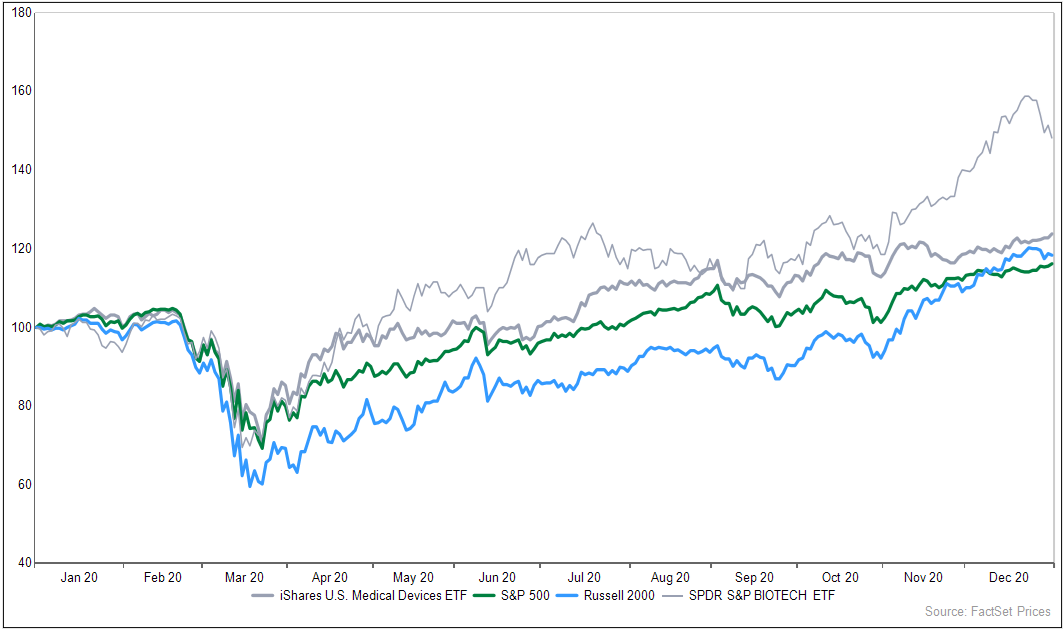
2020 was a unique year given the pandemic that began in early March. In terms of healthcare policy, Trump vied for a rollback of the affordable care act while Biden looked to extend healthcare coverage to DREAMers.
For Biotech, 2020 was an exceptionally strong year, fueled by demand for the rapid development of COVID vaccines, and saw valuations reach historic highs as generalist funds bought into innovative therapeutics. However, after Donald Trump failed to secure the re-election and the Democrats gained unified control of the Congress and presidency, fund flows sharply reverted. From its peak in early February 2021 through mid-February 2022, the XBI was down 49%, led by smid-cap Biotechs, in a post-pandemic return to normalcy.
2016 – Party: Republican
Healthcare initiative per candidate: Trump = complete repeal of Affordable Care Act. Clinton = maintain and build upon Affordable Care Act
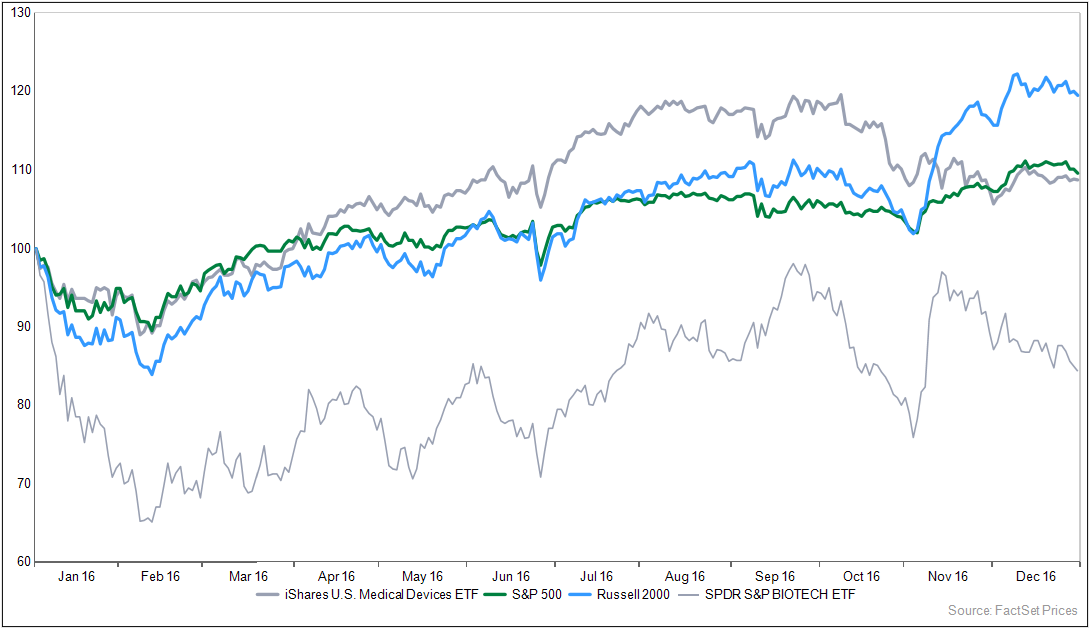
The 2016 election saw Hillary Clinton face off against Donald Trump, each looking to enter the office for the first time. Donald Trump ran on the idea of a complete repeal of the Affordable Care Act that former President Barack Obama championed. Hillary Clinton on the other hand looked to maintain and build upon the Affordable Care Act.
Heightened political and regulatory uncertainty surrounding drug pricing and healthcare policy leading up to the 2016 elections created an overhang on the Biotech sector, particularly in the weeks just before the election when a Democratic victory appeared likely. However, the overhang was abated with the Republican sweep in the executive and legislative branches, along with the rejection of Proposition 61 in California, resulting in the XBI gaining over 15% in the week following the election results.
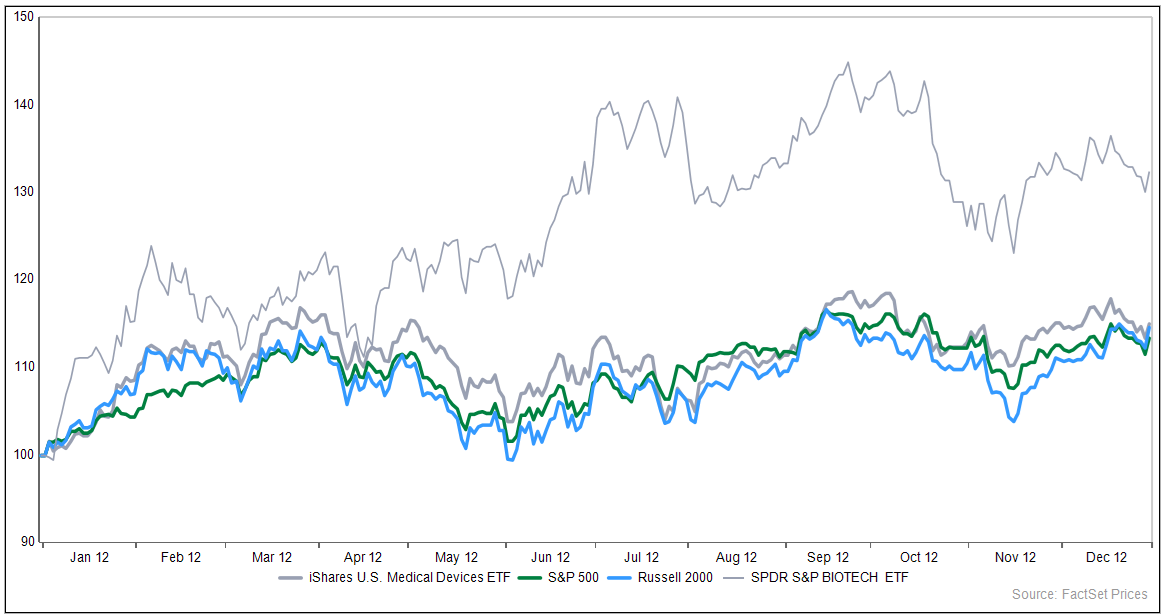
2012 – Party: Democrat
Healthcare initiative per candidate: Obama = Fully implement Affordable Care Act. Romney = more limited regulation, buy health plans in individual markets
Barack Obama ran for his second term in 2012 and ended up defeating the republican challenger Mitt Romney. As it relates to healthcare, Obama looked to fully implement the Affordable Care act while Romney sought more limited regulation and buy health plans in the individual markets.
Biotech was the best performing healthcare subsector in 2012 and the presidential election had a relatively muted impact on performance. An Obama victory ratified the status quo and alleviated any uncertainties related to a full repeal and reform of the Affordable Care Act.
In Summary
With the potential for increased market volatility in the coming months ahead of the 2024 election, investor focus continues to center on business execution. For help in strategic positioning and investor relations planning for upcoming election cycle, please do not hesitate to reach out to the team at Gilmartin Group.
Gilmartin Group has extensive experience working with both private and public companies across the MedTech and Biotech spaces. To find out more about how we strategically partner with our clients, please contact our team today.
Authored by: Jack Droogan, Associate, Vivian Cervantes, Managing Director & Claire McCardell, Associate Vice President, Gilmartin Group